
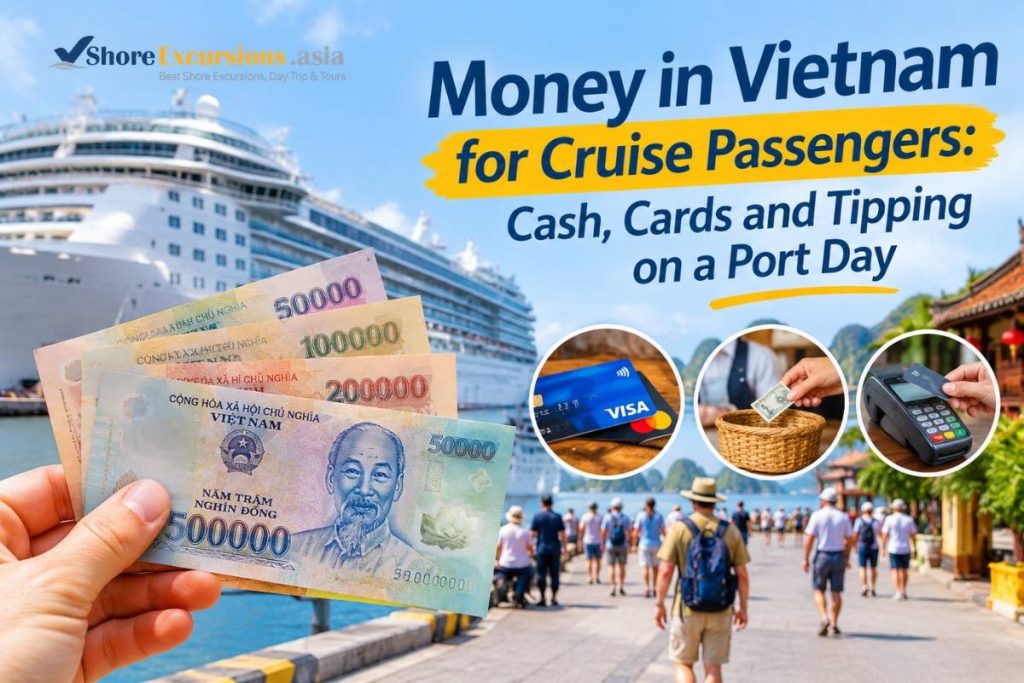
Money in Vietnam on a cruise port day comes down to a string of small payments: a cold drink near the pier, a coffee in an air-conditioned café, a bowl of noodles at a market stall, and a thank-you for the guide at the end. Decisions that feel trivial at home, such as whether to tap a card or look for an ATM, can eat into the few hours you actually have ashore. Vietnam is also a country where cash still does much of the work, which surprises many first-time visitors.
This guide from Vietnam Shore Excursions explains what to carry, where to get it and how much to hand over, so you spend the day looking around rather than looking for a cash machine.
Quick Note: For a cruise port day in Vietnam, carry some dong in small notes and keep a Visa or Mastercard as backup. Hotels, malls and larger restaurants take cards, but markets and street food stalls mostly want cash. US dollars are rarely accepted, and tipping is optional, with 50,000 – 100,000 VND a common thank-you for a guide.
What Is Vietnam’s Currency and What Is It Worth?
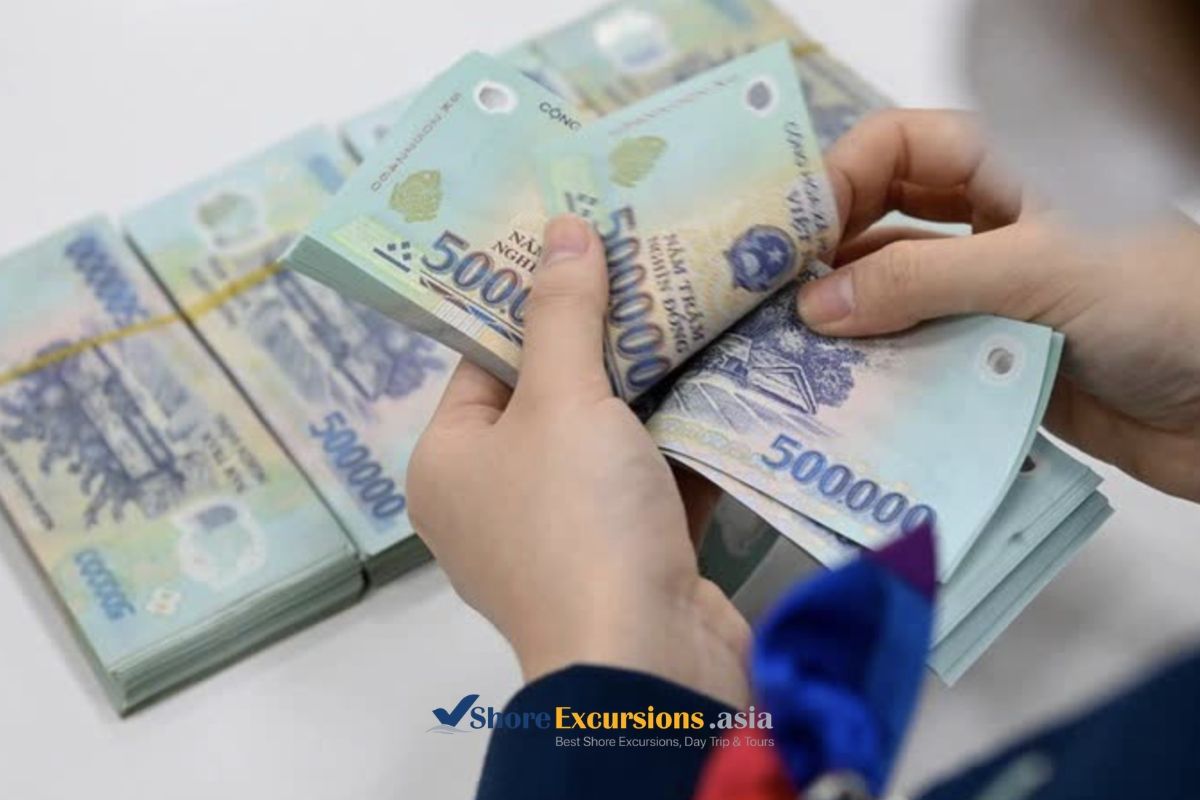
The currency in Vietnam is the dong, written VND or ₫. On 5 November 2026 the State Bank of Vietnam set its reference rate at 25,623 VND per US dollar, and Vietcombank listed a buying rate of 25,510 and a selling rate of 25,890 that morning. For quick mental maths, 100,000 VND is about US$3.90 / 500,000 VND is about US$19.50, and 20,000 VND is under one dollar. Rates move every day, so check a bank website on the morning you arrive.
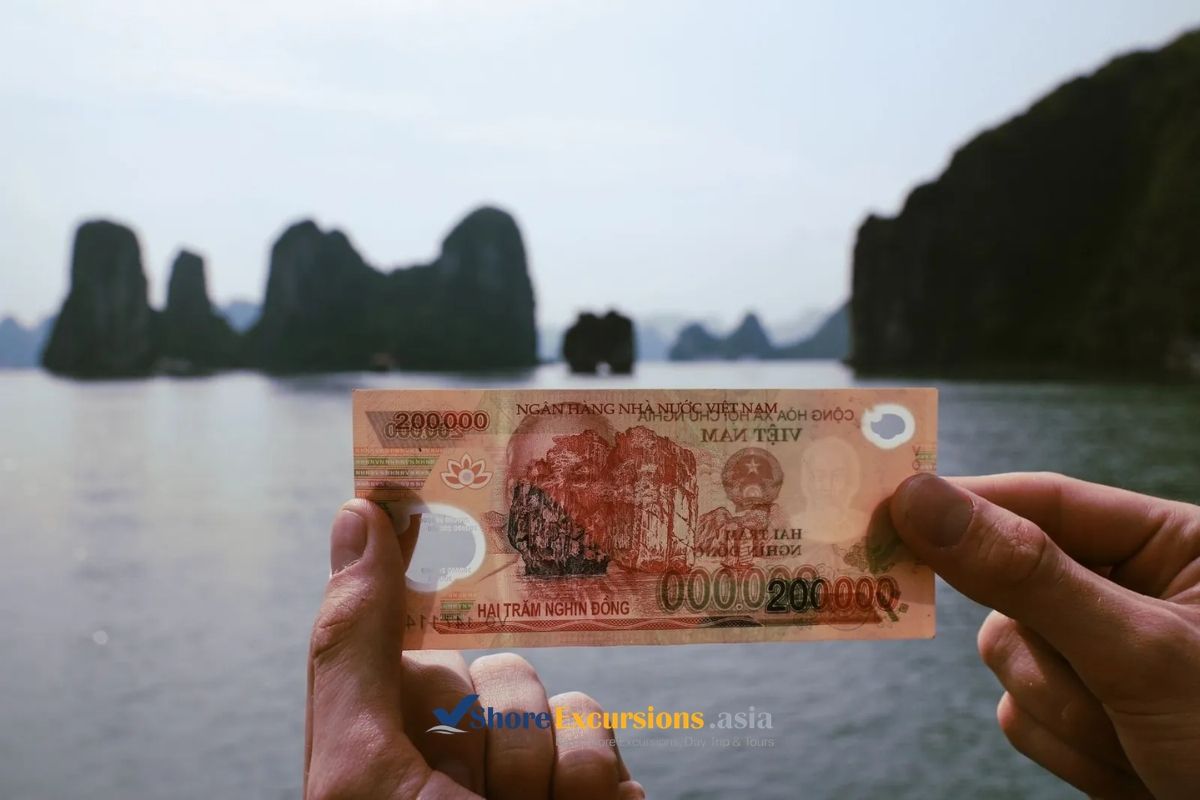
Big numbers cause most of the trouble on a short port day. Banknotes carry many zeros, and the 20,000 and 500,000 notes are both blue-toned, which makes them an easy mix-up when you are paying in a hurry. Count the zeros before you hand a note over, and keep small notes (10,000 VND to 50,000 VND) in a separate pocket from the large ones. That one habit prevents most of the expensive mistakes at market stalls and with taxi fares.
Cash or Card: What Works on a Port Day in Vietnam?
Most cruise passengers spend six to ten hours ashore, so you will pass through several kinds of places in one day. Some accept cards without fuss, and others only take notes. Knowing which is which before you leave the ship saves you from queuing at an ATM while the all-aboard time gets closer.
Where cards usually work
Hotels, chain cafés, supermarkets, shopping malls and larger restaurants generally accept Visa and Mastercard. Some businesses add a surcharge of roughly 2–3%, so ask before you tap. If the terminal offers to charge you in US dollars or your home currency, choose dong. That conversion is set by the merchant’s bank, and the rate is usually worse than the one your own card issuer would apply.
Where you need cash in Vietnam Dong
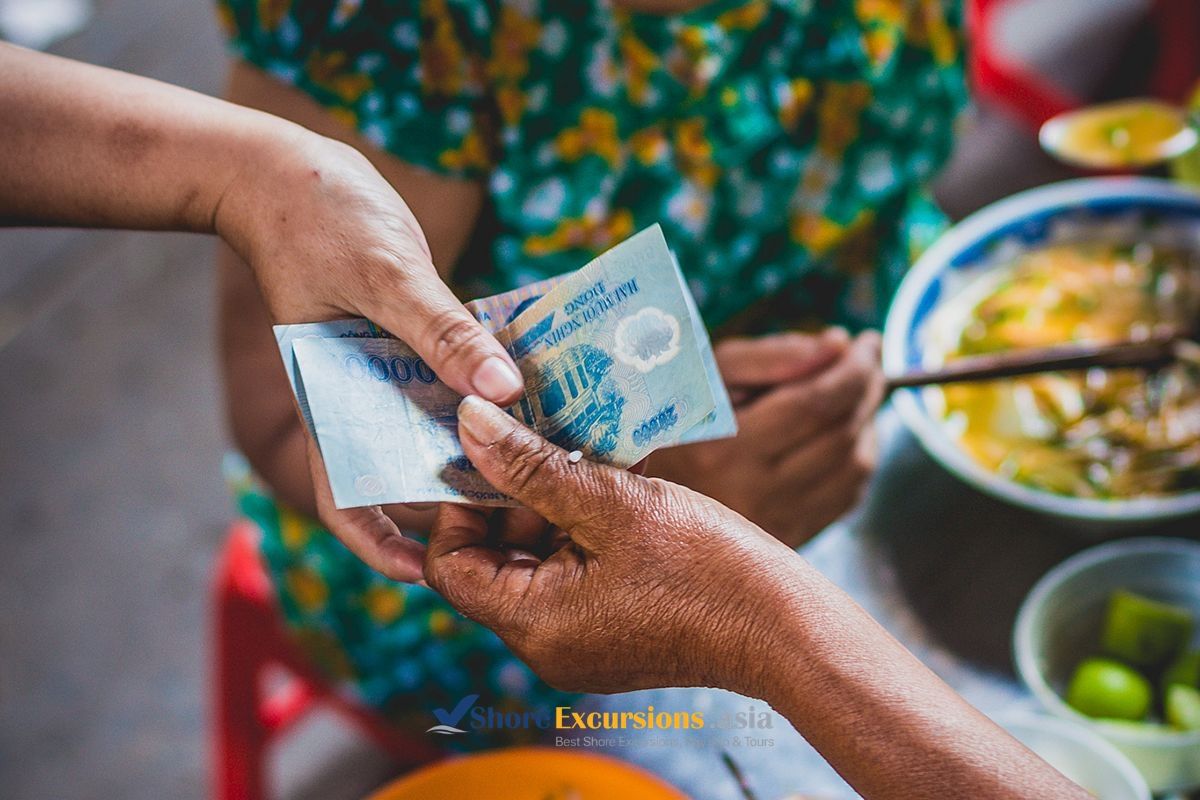
Street food stalls, traditional markets, small family restaurants, local buses, parking attendants and many small ticket counters are cash only. Ben Thanh Market in Ho Chi Minh City and Dong Ba Market in Hue both run on notes and hand-counted change. Tourist-facing shops in towns like Hoi An may take cards, but food stalls and small vendors will not.
How to Get Vietnam Dong Before and During Your Port Day
There are four realistic ways to get local cash, and each has a trade-off. The table below compares them so you can choose before you step off the ship.
| Option | Good for | Watch out for |
|---|---|---|
| ATM | Rates close to the interbank rate | Local fee, commonly reported at 20,000 – 55,000 VND per withdrawal, plus your home bank’s charge of about 1 – 3% |
| Bank or licensed exchange counter | Clear receipts and legal certainty | Opening hours; torn or marked foreign notes may be refused |
| Licensed gold shop (cities) | Often competitive rates | Use established shops only and count your dong at the counter |
| Ship guest services | Convenience before you land | Ask for the rate first, since it is often less favourable |
ATM limits vary a lot. Many machines cap a single withdrawal at 2 – 5 million VND, while a few allow up to 10 million. Travel guides in 2026 commonly name VPBank as the machine that charges foreign cards no fee of its own, but policies change, so read the fee screen before you confirm.
ATMs in Vietnam dispense dong only, and most return your card before the cash, so take the card first. Cover the keypad when you enter your PIN, and tell your home bank you will be in Vietnam so it does not freeze the card.
Several of Vietnam’s cruise terminals sit well away from the nearest town, so do not count on finding an ATM beside the ship. Our Vietnam cruise ports guide explains where each terminal is, which helps you decide where to stop for cash.
How Much Vietnamese Cash Should You Carry?
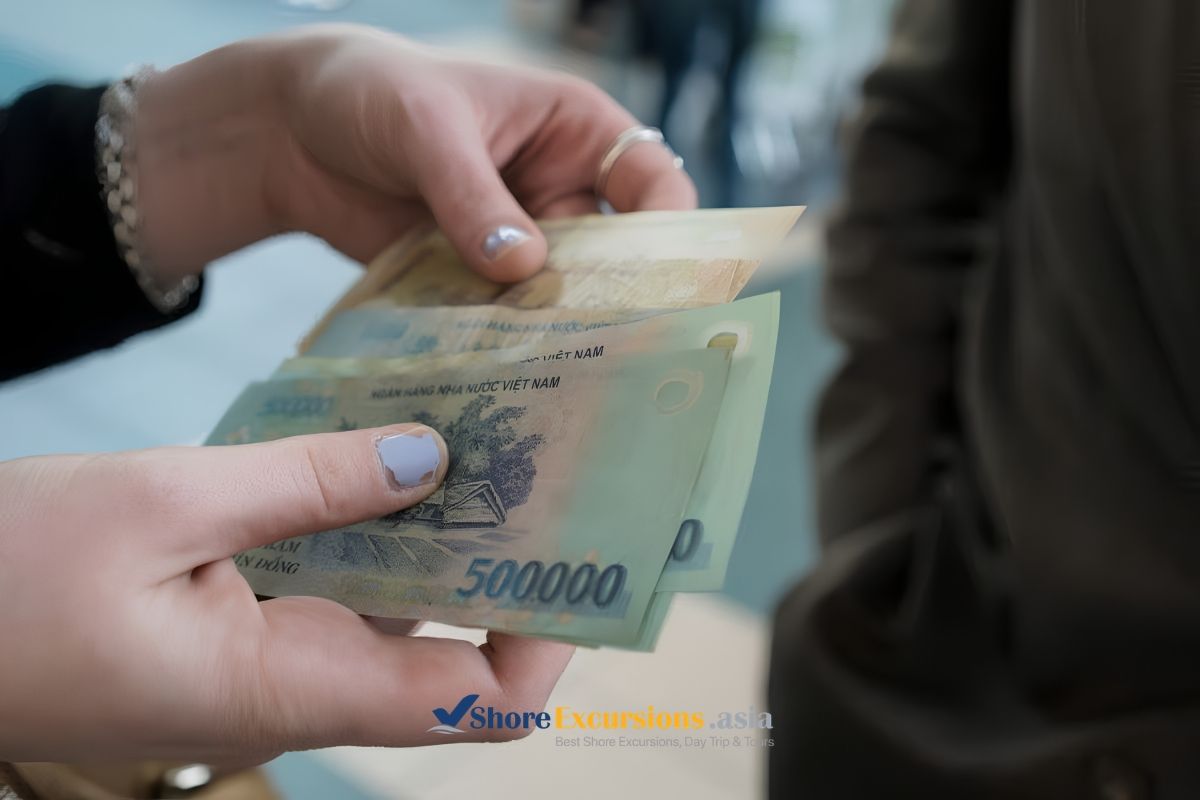
The right amount depends on how much of your day is prepaid and how much you plan to buy. The ranges below are planning suggestions rather than a price list, and they assume one adult.
| Spending type | Suggested cash (VND) | Approx. USD |
|---|---|---|
| Water, snacks, toilets, coffees | 100,000 VND – 200,000 VND | $4 – $8 |
| Street food and local lunch | 150,000 VND – 300,000 VND | $6 – $12 |
| Markets and souvenirs (set your own cap) | 500,000 VND – 1,000,000 VND | $20 – $39 |
| Tips in small notes | 100,000 VND – 300,000 VND | $4 – $12 |
If your outing is fully prepaid, 300,000 – 500,000 VND usually covers drinks, one small purchase and tips. If you plan to eat and shop independently, 700,000 – 1,500,000 VND (about $27 – 59) is a comfortable range. Vieynam Dong can be hard to exchange back in many countries, so it is better to carry a little too little than a lot too much.
Tipping Culture with Money in Vietnam
Tipping is not obligatory in Vietnam, and guides disagree on exact amounts. The figures below reflect ranges that appear often in 2026 travel sources, so treat them as a sensible middle rather than a rule.
| Who | Common range | Note |
|---|---|---|
| Guide, group outing | 50,000–100,000 VND per person | Pool with others if you prefer |
| Guide, private full day | 150,000–200,000 VND, or 10–15% of the service cost | Top of the usual range |
| Driver | 25,000–100,000 VND per day | Often about half the guide’s tip |
| Taxi or ride-hailing | Round up the fare | Fares are metered or fixed |
| Street vendors, market sellers, public buses | Nothing expected | Bargain, then pay the agreed price |
Common Mistakes when Spending Money in Vietnam on a Port Day
Most of these errors are small on their own, but together they can cost you time and a few dollars. Check the list against your plan before you go.
- Leaving the ATM stop until the final hour before all-aboard.
- Accepting a card terminal’s offer to convert the charge into your home currency.
- Carrying only 500,000 notes, which many small vendors cannot break.
- Paying in US dollars at a shop that sets its own exchange rate.
- Exchanging at the first counter you see without comparing the rate.
- Forgetting to tell your home bank about the trip.
- Bringing torn or marked foreign banknotes to an exchange counter.
Quick Checklist Before You Leave the Ship
Use this short list as the last check before you walk down the gangway. It takes about two minutes and covers the points that matter most.
- One Visa or Mastercard, plus a second card kept on the ship.
- 300,000 – 500,000 VND in small notes if you already hold some dong.
- A plan for where you will stop for an ATM or exchange.
- Tips set aside in separate small notes.
- The day’s exchange rate saved on your phone.
For wider planning, our Vietnam travel guide for cruise passengers covers the rest of the preparation.
Frequently Asked Questions about Money in Vietnam
What is the currency in Vietnam?
The currency is the Vietnamese dong (VND). In early November 2026 one US dollar was worth about 25,600 dong at the official reference rate.
Is it better to use an ATM or exchange cash in Vietnam?
For most cruise passengers an ATM is simpler, because the rate is close to the interbank rate and no foreign notes need to be carried. The trade-off is the fee, which combines the local machine’s charge and your home bank’s. If you carry foreign cash, use a bank or licensed exchange and bring clean, undamaged notes.
How much cash can I carry into or out of Vietnam?
There is no fixed cap, but you must declare more than USD 5,000 or VND 15 million (about US$585) when entering or leaving through an international border gate. This comes from State Bank of Vietnam Circular 15/2011/TT-NHNN. Most cruise passengers will be far below these amounts.
Can I use a credit card in Vietnam?
Yes, in many places. Hotels, supermarkets, malls, chain cafés and larger restaurants usually accept Visa and Mastercard, though some add a surcharge of about 2 – 3%. Markets, street food stalls and small vendors are mostly cash only, so carry dong for those.
Can I pay with US dollars in Vietnam?
Mostly no. Payments inside the country are meant to be made in dong, with exceptions such as banks and licensed exchanges. A few tourist-oriented shops take dollars, but they choose their own rate, which rarely works in your favour.
Do you have to tip in Vietnam?
No, tipping is optional. For a guide on a group outing, 50,000 – 100,000 VND per person is a common thank-you, and a driver often receives a similar or smaller amount. Hand the tip over in dong and in small notes.
What should I do with leftover Vietnam Dong?
Spend it on snacks, drinks or a small souvenir before you board. Dong can be hard to exchange back in many countries, so it rarely makes sense to carry more than you expect to use.
Money in Vietnam is simple once you know the pattern: dong in small notes for everyday spending, one card as backup, and an ATM stop early in the day. Pay in dong rather than dollars, choose dong when a card terminal asks, and set aside a few small notes for a guide or driver who made your day easier.
Prices, fees and limits shift from one month to the next, so use the figures in this guide as a starting point and confirm them before you go. With the cash question settled before you step off the ship, you can spend your hours ashore on the sights, the food and the people instead of on the nearest ATM queue.


 Send Inquiry