
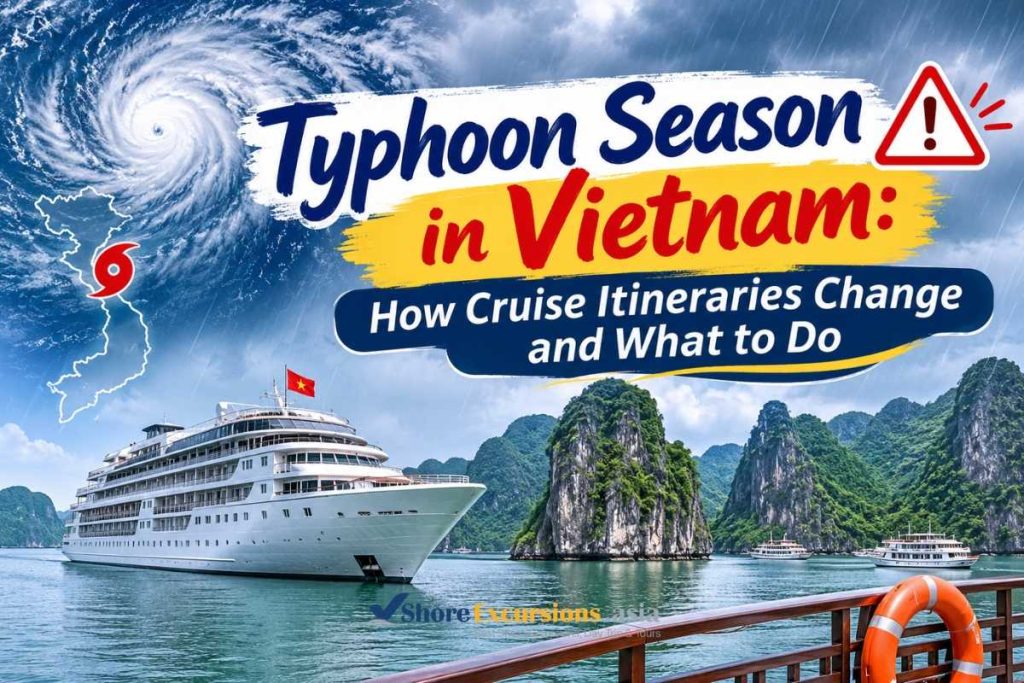
Typhoon season in Vietnam runs from about June to November. Halong Bay is most exposed from July to September, and central ports such as Chan May peak between September and November. When a storm threatens, the captain can reorder ports, add a sea day or swap a port, and compensation is usually limited to port fees and prepaid ship tours.
If your Vietnam cruise falls between June and December, there is a fair chance you will receive a letter from the cruise line about a revised itinerary. Most of these changes are small, such as swapping the order of two ports or leaving the dock earlier in the evening. This guide from Vietnam Shore Excursions explains when storms are most likely, how the decision is made on board, and how to protect the plans you made yourself.
What Typhoon Season Means for a Vietnam Cruise
Vietnam does not get hurricanes, but it does get typhoons, which are the same kind of tropical cyclone with a Pacific name. They form over the western Pacific, cross into the East Sea (the South China Sea) and bring strong wind, heavy rain and flooding when they reach the coast.
For a ship, the main concerns are rough water, unsafe berthing and port closures rather than the rain itself. For a passenger, the practical result is a changed schedule and, now and then, a cancelled call.
When and Where Storms are Most Likely in Vietnam
Vietnam is a country with long coast line, so the storm calendar depends on which port you are calling at. The table below summarises the windows most often quoted by Vietnamese media and travel sources, and individual years can differ a great deal.
| Region and cruise ports | Higher-risk months | What it usually means for a ship |
|---|---|---|
| North: Halong Bay | July to September | Rough water, poor visibility, an occasional skipped call |
| Central: Chan May (for Hue, Da Nang, Hoi An) | September to November, peaking in October and November | The highest chance of a shortened or skipped call |
| South-central: Nha Trang and Cam Ranh | September to November | Heavier rain and swell, with fewer direct hits than the central coast |
| South: Phu My (for Ho Chi Minh City) | Rarely hit directly | Heavy seasonal rain, but a low typhoon risk |
Averages hide big swings from one year to the next. Vietnam’s National Center for Hydro-Meteorological Forecasting (NCHMF) expected a quieter autumn in 2026 because of a strong El Niño, with three to five storms or depressions in the East Sea between September and November and only one or two landfalls.
By early November, just two systems had reached the mainland. By contrast, 2025 was the region’s second-busiest storm year in three decades, so a calm forecast is a reason to relax a little, not to stop checking.
How a cruise itinerary change works during typhoon season in Vietnam
Itinerary changes follow a fairly consistent pattern across cruise lines, although the exact rules sit in each line’s booking terms. Knowing the sequence helps you decide when to worry and when to simply wait for the official notice.
Who decides, and when
The captain makes the final call together with the ship’s meteorologist and the line’s operations team, and safety always outranks the published schedule. Sometimes you receive several days of warning through a letter or the ship’s app. In other cases the decision comes the evening before arrival or on the morning itself, when swell or wind makes berthing unsafe. Those late calls are the ones that catch privately arranged plans out.
What the cruise line can change
Lines usually choose from a short menu of fixes, so it helps to know what to expect:
- Arrival and departure times. This is the most common tweak, and it is the one most likely to shorten a day on land.
- Port order. The ship may visit Phu My earlier or later than planned to keep clear of a storm track.
- A sea day. This replaces a port when no safe alternative is within reach.
- A substitute port. The replacement can be in a different region or even a different country.
What you usually get back
Compensation is limited and is set by the contract you accepted when you booked. Royal Caribbean and Carnival both state that a changed itinerary gives no right to cancel or claim, and that a missed port is met with a refund of port taxes and fees plus any cancelled pre-purchased ship excursions.
Cruise Critic puts the port-fee refund at roughly $10 to $20 per person, normally paid as onboard credit. Some lines add goodwill credit after larger disruptions, but you should not plan around it. Check your own line’s itinerary-change policy, because terms differ by line and sometimes by sailing.
How to protect your own port-day plans
Ship excursions are refunded automatically when a call is cancelled, but anything you booked yourself is a separate contract. Chan May is a working cargo port with little public transport at the gate, so most passengers rely on transfers arranged in advance. That means a schedule change affects the driver, the guide and the lunch booking all at once.
Before paying a deposit to any private provider, ask three questions:
- What happens if the ship skips the port?
- What happens if the ship arrives late or leaves early?
- Can I move the date or get a refund, and is that written down?
It is also worth checking whether your tour operator has a specific policy for port cancellations caused by Force Majeure. For example, Vietnam Shore Excursions has a dedicated provision in its Cancellation & Refunds policy for situations where a cruise ship cannot dock or tender passengers ashore due to Force Majeure events.
Under this policy, if the ship is unable to dock or tender passengers cannot disembark, the operator will refund the cost of lunch and entrance fees, where applicable. However, guide and vehicle expenses are treated differently. Since these services may already have been arranged and dispatched to the port, Vietnam Shore Excursions will negotiate with its local service providers to minimize cancellation charges. The company will then inform passengers of the specific refund amount once it has assessed the costs involved.
Read our policy here: https://www.vietnamshoreexcursions.asia/terms-conditions/
Checklist: before, during and after
Preparing for a possible port cancellation is easier when you know what to check at each stage of your cruise. Use this checklist to reduce the risk of losing money, missing important updates or being caught off guard by a last-minute itinerary change.
Before you book
- Read your cruise line’s itinerary-change and cancellation policies, paying particular attention to what happens when a port is skipped due to bad weather or other operational reasons.
- Check your travel insurance policy to understand what qualifies as a covered missed port. A change to the cruise itinerary does not automatically mean you are entitled to compensation.
- Choose private tour operators that offer flexible booking, rescheduling or cancellation options.
- Ask your tour provider about its Force Majeure policy. For example, Vietnam Shore Excursions has specific provisions for port cancellations when a ship cannot dock or tender passengers ashore due to Force Majeure. Its policy provides for refunds of applicable lunch and entrance fees, while guide and vehicle costs are assessed separately, with the operator negotiating with local providers to minimize cancellation charges.
- Keep a copy of the booking confirmation and written cancellation and refund terms so you know exactly what to expect if your port call is cancelled.
In the two weeks before sailing
- Monitor weather forecasts and tropical storm warnings through the National Centre for Hydro-Meteorological Forecasting (NCHMF) and track developing systems through the Joint Typhoon Warning Center (JTWC).
- Stay in contact with your private tour provider and make sure you have a working phone number or messaging contact for last-minute updates.
- Check whether your tour operator can accommodate changes to the ship’s arrival time or itinerary.
- Avoid booking a flight home on the same day as your final port call, as weather disruptions can lead to unexpected schedule changes.
On the day of your port call
- Follow the cruise ship’s official announcements and instructions rather than relying on unverified social media reports.
- If the ship announces a delayed arrival, revised docking time or itinerary change, contact your tour provider immediately to confirm whether the excursion can still go ahead.
- Reconfirm the meeting point, pickup time and contact details with your guide before leaving the terminal.
- Keep some flexibility in your schedule, particularly if rain or poor road conditions could affect travel times.
- Return to the ship well before the official all-aboard time. Do not rely on the final minutes, as wet roads, traffic congestion and unexpected delays can make the journey back to Chan May Port longer than expected.
Common mistakes when traveling in typhoon season in Vietnam
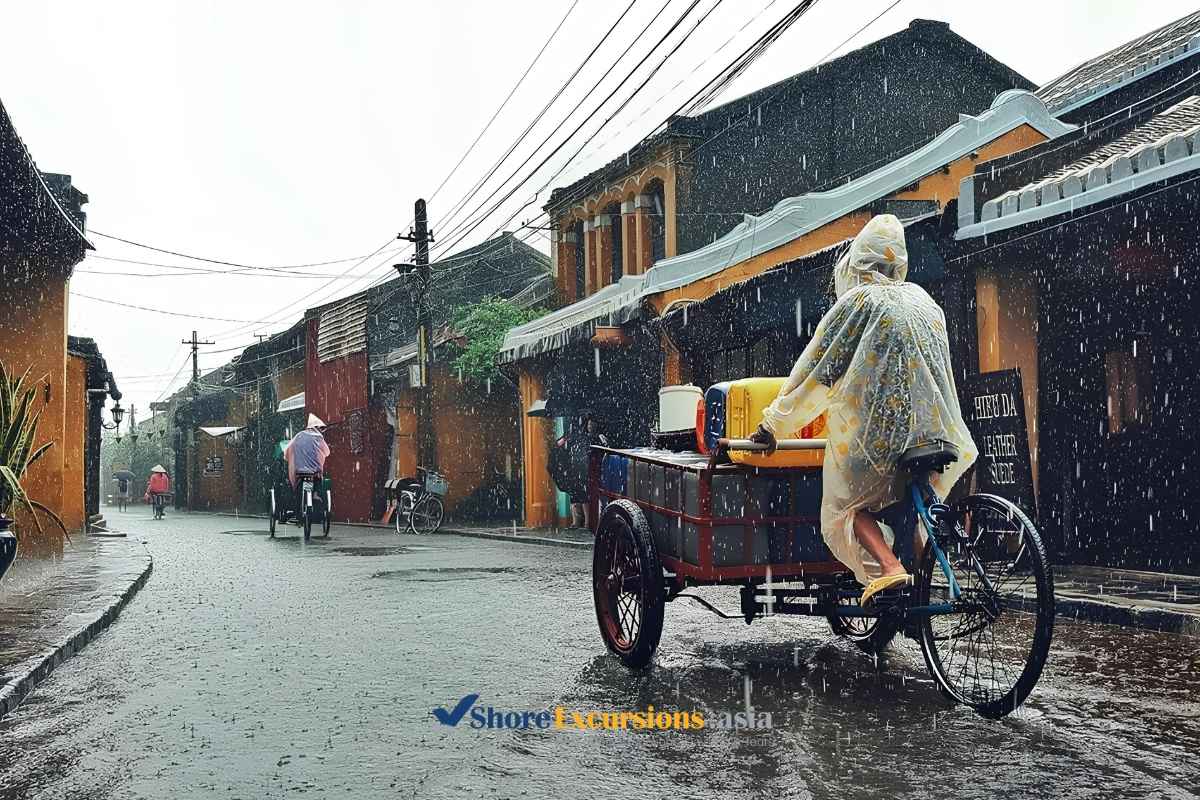
Many port-day disruptions and unnecessary expenses can be traced back to a few common planning mistakes. Understanding these pitfalls before your cruise can help you make better decisions and avoid unpleasant surprises.
- Planning around average rainfall. The forecast for your sailing week matters more than the long-term pattern.
- Treating every port as equally risky. Halong Bay, Chan May and Phu My have very different storm calendars.
- Paying in full for a rigid booking. A deposit with no weather clause leaves you exposed if the call is cancelled.
- Expecting a refund for a swapped port. Under most cruise contracts, a substitute port or sea day does not entitle you to anything.
- Cutting the return too tight. A flooded road can add an hour or more to the drive back.
- Ignoring Force Majeure clauses. Not every port cancellation guarantees a full refund, especially when transport and guide services have already been arranged.
- Booking non-refundable flights or hotels. A missed port or itinerary change can disrupt onward travel plans.
- Relying only on weather apps. Local port authorities and the cruise captain make the final decisions based on actual sea and docking conditions.
- Waiting until the last minute to contact your operator. Early communication gives your guide and driver more time to adjust arrangements.
- Assuming a delayed arrival means cancellation. Some excursions can still go ahead if the ship arrives later than scheduled.
- Forgetting to save booking documents. Written confirmations and payment receipts are essential when requesting a refund.
- Not checking the port’s docking conditions. Rough seas may prevent tender operations even when rainfall is light.
- Confusing travel insurance with tour refunds. Your insurance coverage and your tour operator’s cancellation policy are two separate matters.
FAQs about Typhoon Season in Vietnam
1. When is typhoon season in Vietnam?
Vietnam’s typhoon season generally runs from May to November, but the timing varies by region. Northern and Central Vietnam are typically more exposed from July to November, while Southern Vietnam tends to experience more tropical weather earlier in the season. October and November are particularly important months to watch if your cruise calls at Central Vietnam.
2. Which months are riskiest for cruise ports in Vietnam?
October and November are generally the most concerning months for Central Vietnam, including Chan May and nearby destinations such as Hue and Da Nang. Northern ports, including Halong Bay, can face tropical storms from summer through autumn. Weather risks vary by year, so check forecasts closer to your sailing date.
3. Can cruise ships skip Vietnamese ports because of typhoons?
Yes. Cruise ships may skip a scheduled port, change their arrival time or replace a port call with a sea day if strong winds, high waves or unsafe docking conditions are expected. The captain and relevant port authorities prioritize passenger safety, so itinerary changes can happen even when the weather looks manageable on land.
4. Is it safe to book a private shore excursion during typhoon season?
Yes, provided you choose a reputable operator with clear cancellation terms and flexible arrangements. Ask about missed-port refunds, Force Majeure conditions and what happens if the ship arrives late or leaves early. Avoid paying the full amount upfront unless you understand which costs are refundable.
5. How far in advance can I know if a port will be cancelled?
There is no fixed timeframe. Cruise lines may announce itinerary changes several days in advance when a storm is approaching, but decisions can also be made on the day of arrival. Monitor official cruise updates and weather warnings, but treat the ship’s announcements as the final source of information.
6. Should I cancel my shore excursion if rain is forecast?
Not necessarily. Rain alone does not mean a port call or shore excursion will be cancelled. Check the severity of the forecast, potential flooding, wind conditions and any official warnings. Stay in contact with your tour operator before making a decision.
7. Which Vietnamese cruise port is most affected by typhoons?
There is no single answer because each region has a different storm season. Chan May and other Central Vietnam destinations are particularly exposed to tropical storms and heavy rainfall in autumn. Halong Bay faces tropical weather risks during the summer and autumn, while Phu My and Southern Vietnam generally have a different seasonal pattern.
Typhoon season rarely ruins a Vietnam cruise, but it does reward people who plan with a little flexibility. Learn which ports carry the most risk on your dates, read your line’s change policy, and book private plans that allow for a revised schedule. If you would like help building a port-day plan that follows your ship’s timetable, you can reach the team at Vietnam Shore Excursions.


 Send Inquiry